
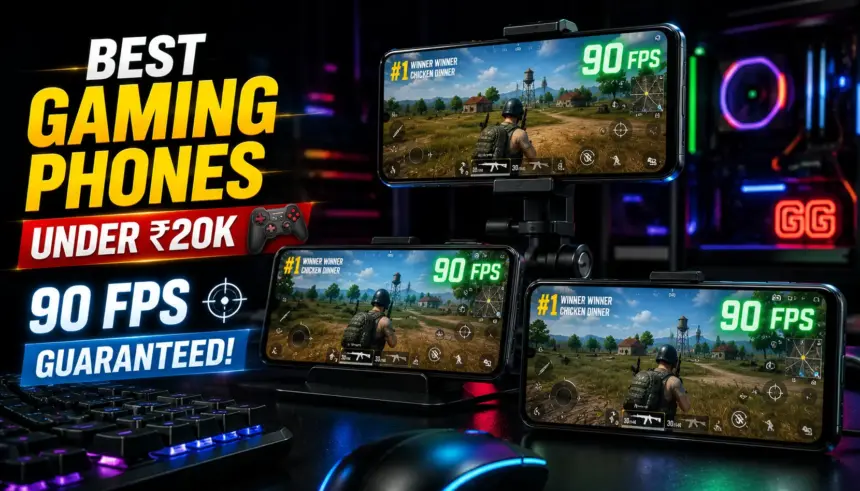
If you are a hardcore mobile gamer playing titles like BGMI, Free Fire Max, or Genshin Impact, you know that frame drops and heating issues can cost you the match. A few years ago, getting a dedicated gaming phone meant spending over ₹50,000. In 2026, the ₹20,000 segment has completely transformed.
Smartphone manufacturers are now packing mid-range devices with incredibly powerful processors (like the MediaTek Dimensity 7200 and Snapdragon 7s Gen 2), massive vapor chamber liquid cooling systems, and ultra-responsive 144Hz displays with 360Hz touch sampling rates.
Whether you are an aspiring esports athlete or a casual gamer looking for sustained 90fps, we have tested and ranked the top 10 best gaming phones under ₹20,000 based on benchmark scores, sustained frame rates, thermal management, and battery life.
Quick Answer
The absolute best gaming phone under ₹20,000 is the iQOO Z9 5G. Armed with the Dimensity 7200 processor and excellent vapor cooling, it delivers sustained 90fps in BGMI without overheating. For users who prefer Qualcomm processors, the POCO X6 5G with the Snapdragon 7s Gen 2 offers incredibly smooth performance and a stunning 1.5K display. If you want maximum refresh rates, the Motorola G85 5G offers a blazing 144Hz display for ultra-smooth arcade gaming.
Comparison Table
| Product | Processor | AnTuTu Score | Max BGMI FPS | Display (Refresh Rate) | Cooling System |
|---|---|---|---|---|---|
| iQOO Z9 5G | Dimensity 7200 | ~7,20,000 | 90 FPS | 6.67″ AMOLED (120Hz) | 3000mm² VC Liquid |
| POCO X6 5G | Snapdragon 7s Gen 2 | ~6,10,000 | 60 FPS (Ultra) | 6.67″ 1.5K AMOLED (120Hz) | Graphite + VC |
| Realme Narzo 70 Pro | Dimensity 7050 | ~6,00,000 | 60 FPS | 6.67″ AMOLED (120Hz) | 4356mm² VC Cooling |
| Infinix GT 20 Pro | Dimensity 8200 | ~9,00,000 | 90 FPS | 6.78″ AMOLED (144Hz) | Dedicated Gaming Chip |
| Motorola G85 5G | Snapdragon 6s Gen 3 | ~5,50,000 | 60 FPS | 6.67″ pOLED (144Hz) | Standard Graphite |
| Vivo T3 5G | Dimensity 7200 | ~7,20,000 | 90 FPS | 6.67″ AMOLED (120Hz) | Standard VC |
| Redmi Note 13 Pro | Snapdragon 7s Gen 2 | ~6,10,000 | 60 FPS | 6.67″ 1.5K AMOLED (120Hz) | Graphene Cooling |
| OnePlus Nord CE 4 Lite | Snapdragon 695 | ~4,20,000 | 40 FPS | 6.67″ AMOLED (120Hz) | Standard |
| Lava Agni 3 5G | Dimensity 7050 | ~5,80,000 | 60 FPS | 6.78″ Curved AMOLED (120Hz) | VC Cooling |
| Tecno Pova 6 Pro | Dimensity 6080 | ~4,30,000 | 40 FPS | 6.78″ AMOLED (120Hz) | 2874mm² VC |
Main Content
1. iQOO Z9 5G
Overview: iQOO is synonymous with gaming, and the Z9 5G proves why. It is powered by the incredibly efficient MediaTek Dimensity 7200, which is built on a 4nm architecture. This means it generates less heat while providing massive power, easily hitting 90fps in BGMI on smooth graphics.
* Pros: Unmatched gaming performance in this segment; sustained 90fps in BGMI; very bright 1800-nit display; excellent vapor chamber cooling.
* Cons: The design is slightly generic; single bottom-firing speaker is easy to muffle with your hand.
* Verdict: The undisputed champion for hardcore BGMI and Free Fire players who prioritize frame rates over everything else.
2. POCO X6 5G
Overview: POCO’s X-series is legendary for bringing premium specs to the budget segment. The X6 5G utilizes the Snapdragon 7s Gen 2 and features a stunning 1.5K AMOLED display. Not only do games run smoothly, but they look incredibly sharp and vibrant.
* Pros: Gorgeous 1.5K resolution display; reliable Snapdragon processor; super-fast 67W charging.
* Cons: HyperOS has intrusive system ads; battery drains slightly faster on 1.5K resolution.
* Verdict: The best phone for gamers who want a balance of high performance and visual fidelity for games like Genshin Impact.
3. Infinix GT 20 Pro
Overview: Technically priced just on the border of ₹20,000 (often dropping below during sales), the Infinix GT 20 Pro is a dedicated gaming beast. It features a Cyber Mecha design with LED lights on the back, a massive Dimensity 8200 processor, and a dedicated Pixelworks gaming display chip.
* Pros: Aggressive gamer aesthetic with RGB lights; dedicated gaming chip for frame interpolation; blazing 144Hz refresh rate.
* Cons: XOS software feels cluttered; camera performance is strictly average.
* Verdict: For the unapologetic “Gamer” who wants RGB lights and maximum AnTuTu scores to show off to friends.
4. Realme Narzo 70 Pro 5G
Overview: Realme’s Narzo series targets young gamers, and the 70 Pro features the largest Vapor Chamber (VC) cooling system in this price segment (4356mm²). This ensures that even after a 3-hour gaming marathon, the phone remains comfortably cool to the touch.
* Pros: Massive cooling system prevents thermal throttling; excellent 50MP Sony IMX890 camera (rare for a gaming phone); air gesture support.
* Cons: Dimensity 7050 is slightly older; maxes out at 60fps in BGMI.
* Verdict: The best option for marathon gamers who hate when their phone overheats during summer gaming sessions.
5. Vivo T3 5G
Overview: The Vivo T3 is essentially the iQOO Z9 in a different body. It features the exact same Dimensity 7200 processor and delivers the same 90fps BGMI experience. However, it swaps out some of iQOO’s aggressive styling for a sleeker, more lifestyle-focused design.
* Pros: Same elite gaming performance as the iQOO Z9; better portrait camera processing for social media.
* Cons: Funtouch OS is heavily bloated out of the box.
* Verdict: Best for users who want iQOO-level gaming performance but prefer a sleeker, less “gamer-centric” design.
6. Motorola G85 5G
Overview: Motorola brings its clean, ad-free Hello UI to the gaming segment. While the Snapdragon 6s Gen 3 isn’t as powerful as the Dimensity 7200, the G85 features a stunning curved 144Hz pOLED display, making arcade and racing games feel incredibly fluid.
* Pros: Zero bloatware or ads; gorgeous curved 144Hz display; excellent battery life.
* Cons: Cannot hit 90fps in heavy battle royale games; gaming performance is average compared to iQOO.
* Verdict: Best for casual gamers who prioritize a clean, lag-free software experience and a beautiful curved display.
7. Redmi Note 13 Pro
Overview: Xiaomi’s Redmi Note 13 Pro is a solid all-rounder that holds its own in gaming. Powered by the Snapdragon 7s Gen 2, it handles Call of Duty Mobile effortlessly. Its 1.5K display and stereo speakers provide an immersive audio-visual gaming experience.
* Pros: Immersive stereo speakers; sharp 1.5K display; premium glass back design.
* Cons: Heavily bloated software; slightly more expensive than the POCO X6 which shares the same processor.
* Verdict: A great all-rounder for students who want to game, watch movies, and take high-resolution photos on a single device.
8. Lava Agni 3 5G
Overview: Lava is making massive strides in the Indian market. The Agni 3 features the Dimensity 7050 and a beautifully curved AMOLED display. Most importantly, it offers a completely clean, bloat-free Android experience, ensuring all processing power goes directly to your game.
* Pros: Clean stock Android experience; premium curved design; free home service warranty.
* Cons: Heavy and bulky; camera optimizations are still a work in progress.
* Verdict: The best “Make in India” option for gamers who want a bloat-free experience and premium aesthetics.
9. Tecno Pova 6 Pro
Overview: Tecno’s Pova series is famous for its massive batteries. The Pova 6 Pro features a gigantic 6000mAh battery and a mecha-inspired design with mini-LED lights. While the Dimensity 6080 is an entry-level gaming chip, the massive battery ensures you can play all day.
* Pros: Unkillable 6000mAh battery; unique LED design; very affordable.
* Cons: Dimensity 6080 struggles with heavy games on high settings; only hits 40fps in BGMI.
* Verdict: Strictly for budget buyers who want to play casual games for 12 hours straight without reaching for a charger.
10. OnePlus Nord CE 4 Lite
Overview: The Nord CE 4 Lite is the weakest gaming phone on this list, utilizing the ancient Snapdragon 695. However, it is included because of its incredibly stable OxygenOS. If you only play casual games (like Candy Crush or Subway Surfers), the software stability makes it a joy to use.
* Pros: Extremely smooth and stable OxygenOS; great battery life; fast 80W charging.
* Cons: Ancient Snapdragon 695 processor; terrible value for heavy gaming.
* Verdict: Only for die-hard OnePlus fans who play light, casual games and prioritize software over hardware.
Buying Guide
When buying a gaming phone under ₹20,000 in 2026, do not just look at the RAM. Pay attention to these critical specs:
* The Processor is King: The processor (SoC) dictates your frame rates. For this budget, the MediaTek Dimensity 7200 and Dimensity 8200 are the absolute best chips available, followed closely by the Snapdragon 7s Gen 2. Avoid the Snapdragon 695 or Dimensity 6080 if you want to play BGMI.
* Cooling Systems (VC Liquid Cooling): High frame rates generate heat. Heat causes thermal throttling (your phone slows down to cool off). Always buy a phone that advertises a “Vapor Chamber (VC)” cooling system. The larger the VC surface area (measured in mm²), the better.
* Touch Sampling Rate: Refresh rate (120Hz) is how fast the screen updates. Touch sampling rate (e.g., 360Hz or 1200Hz instant) is how fast the screen registers your finger touching it. For competitive shooters, a higher touch sampling rate gives you a split-second advantage.
* Avoid Bloatware if Possible: Phones with heavy UI skins (like MIUI or Funtouch) use up background RAM and processing power. If you buy an iQOO or POCO, spend your first 30 minutes uninstalling all pre-loaded junk apps to free up resources for gaming.
FAQs
1. Which phone gives 90 FPS in BGMI under 20000?
The iQOO Z9 5G (Dimensity 7200), Vivo T3 5G (Dimensity 7200), and Infinix GT 20 Pro (Dimensity 8200) all support 90 FPS in BGMI at this price point.
2. Is Snapdragon better than MediaTek for gaming?
Historically, yes. But in 2026, MediaTek has completely taken over the sub-20K segment. The MediaTek Dimensity 7200 heavily outperforms the equivalent Qualcomm Snapdragon 6 Gen 1 or 6s Gen 3 in both AnTuTu scores and sustained frame rates.
3. Does 12GB RAM make a difference in gaming compared to 8GB?
For gaming alone, 8GB is perfectly fine. The game relies far more on the GPU (graphics processor) than the extra 4GB of RAM. Save your money and buy the 8GB/256GB variant instead of the 12GB/128GB variant.
4. Why does my phone heat up while playing Genshin Impact?
Genshin Impact is an incredibly demanding open-world game that taxes both the CPU and GPU simultaneously. Every phone will heat up. To reduce heating, lower your graphical settings to “Medium” and cap the frame rate at 45fps.
5. Should I use a gaming cooler fan?
If you plan to play for more than 2 hours at a time, yes. A clip-on thermoelectric cooler (costing around ₹1,500) will drop your phone’s temperature by 10°C, ensuring your processor never throttles and your frame rate stays locked at 90fps.
Final Verdict
The ₹20,000 segment is an absolute goldmine for budget gamers. If you want maximum frame rates and sustained 90fps in BGMI, you should blindly purchase the iQOO Z9 5G; its Dimensity 7200 processor is unmatched in this category. If you prefer a sharper display and Qualcomm reliability, the POCO X6 5G with its 1.5K screen is a stunning device. Finally, if you hate overheating, the massive vapor chamber on the Realme Narzo 70 Pro makes it the coolest phone under pressure.
Read more:
- Best Phones Under ₹35,000 in India
- Smartphones with the Best Battery Life
- Best Phones with 256GB Storage
- Top 10 AMOLED Display Phones
Sorce: