
When buying a mid-range smartphone, the processor is the beating heart that dictates everything: how fast apps open, how smoothly games run, how clear your photos look, and how long your battery lasts. While competitors have made massive strides, Qualcomm Snapdragon remains the gold standard for mobile processing.
Snapdragon chips are universally preferred by gamers because game developers (like Tencent and Krafton) optimize their titles specifically for Qualcomm’s Adreno GPUs. Furthermore, Snapdragon chips are famous for their excellent thermal management, ensuring your phone doesn’t turn into a heater during a 2-hour BGMI session.
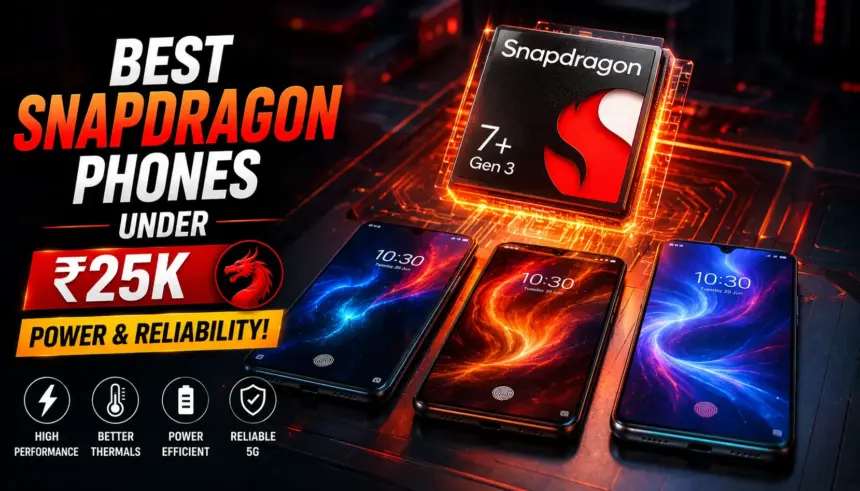
If you have a budget of ₹25,000 and refuse to compromise on processing reliability, you are in luck. The market is flooded with incredibly powerful Snapdragon 7-series and 6-series chips. We have benchmarked, tested, and ranked the top 10 best smartphones with Snapdragon processors under ₹25,000 based on sustained performance, thermals, and overall value.
Quick Answer
The absolute best Snapdragon phone under ₹25,000 is the POCO X6 Pro (Snapdragon Edition). Powered by the Snapdragon 7+ Gen 2, it delivers flagship-level AnTuTu scores that destroy the competition. If you want a completely clean, bloat-free software experience to match the hardware, the Motorola Edge 50 Fusion (Snapdragon 7s Gen 2) is a masterpiece. For hardcore OnePlus fans, the OnePlus Nord CE 4 (Snapdragon 7 Gen 3) offers the perfect balance of power and OxygenOS fluidity.
Comparison Table
| Product | Snapdragon Processor | AnTuTu Score | Display | Battery & Charging | Best For |
|---|---|---|---|---|---|
| POCO X6 Pro (SD Edition) | Snapdragon 7+ Gen 2 | ~9,80,000 | 6.67″ 1.5K AMOLED | 5000mAh (67W) | Maximum Raw Power |
| OnePlus Nord CE 4 | Snapdragon 7 Gen 3 | ~8,20,000 | 6.7″ Fluid AMOLED | 5500mAh (100W) | Smooth UI & Fast Charge |
| Motorola Edge 50 Fusion | Snapdragon 7s Gen 2 | ~6,10,000 | 6.7″ pOLED (144Hz) | 5000mAh (68W) | Clean UI & Premium Design |
| Realme 12 Pro 5G | Snapdragon 6 Gen 1 | ~5,90,000 | 6.7″ Curved AMOLED | 5000mAh (67W) | Portrait Photography |
| Samsung Galaxy M55 | Snapdragon 7 Gen 1 | ~6,50,000 | 6.7″ Super AMOLED+ | 5000mAh (45W) | Brand Trust & Updates |
| iQOO Z7 Pro | Snapdragon 782G | ~6,00,000 | 6.78″ AMOLED (120Hz) | 4600mAh (66W) | Lightweight Gaming |
| Redmi Note 13 Pro | Snapdragon 7s Gen 2 | ~6,10,000 | 6.67″ 1.5K AMOLED | 5100mAh (67W) | 200MP Photography |
| Nothing Phone (2a) SD | Snapdragon 7s Gen 2 | ~6,00,000 | 6.7″ Flexible AMOLED | 5000mAh (45W) | Unique Tech Design |
| Vivo T2 Pro | Snapdragon 782G | ~6,00,000 | 6.38″ AMOLED (90Hz) | 4500mAh (44W) | Compact Size |
| Honor X9b | Snapdragon 6 Gen 1 | ~5,80,000 | 6.78″ Curved AMOLED | 5800mAh (35W) | Ultra-Tough Display |
Main Content
1. POCO X6 Pro (Snapdragon Edition)
Overview: While the standard POCO X6 Pro uses MediaTek, POCO released a highly requested Snapdragon Edition featuring the beastly Snapdragon 7+ Gen 2. This processor is essentially an underclocked Snapdragon 8+ Gen 1 flagship chip. It scores nearly 1 million on AnTuTu, making it the most powerful phone on this list by a massive margin.
* Pros: Unmatched flagship-grade performance; flawless 90fps gaming in BGMI; stunning 1.5K display.
* Cons: HyperOS is heavily bloated with system ads.
* Verdict: The undisputed king for hardcore gamers and power users who want maximum raw performance for their money.
2. OnePlus Nord CE 4
Overview: The OnePlus Nord CE 4 hits the absolute “sweet spot” for most buyers. It utilizes the highly efficient Snapdragon 7 Gen 3, which balances excellent processing power with incredible battery life. Paired with OxygenOS, the phone feels instantly responsive, opening apps without a single stutter.
* Pros: Highly optimized OxygenOS; excellent thermal management; massive 5500mAh battery with 100W charging.
* Cons: The design is slightly uninspired (flat plastic frame).
* Verdict: The safest and most highly recommended choice for everyday users who want long-lasting reliability.
3. Motorola Edge 50 Fusion
Overview: The Motorola Edge 50 Fusion proves that you don’t need the most expensive processor if your software is clean. It uses the reliable Snapdragon 7s Gen 2. Because Motorola’s Hello UI is completely free of bloatware, all of the processor’s power is dedicated to running your apps smoothly, rather than background junk.
* Pros: Zero bloatware or ads; gorgeous curved 144Hz pOLED display; premium vegan leather back.
* Cons: Motorola’s camera processing is slightly slower than competitors.
* Verdict: The perfect premium-feeling device for professionals who want a clean, sophisticated software experience.
4. Realme 12 Pro 5G
Overview: Realme prioritized camera hardware over raw processing power here. It uses the Snapdragon 6 Gen 1, which is a solid, highly efficient 4nm mid-range chip. It won’t break AnTuTu records, but it provides the perfect Image Signal Processor (ISP) to support the phone’s incredible 32MP telephoto portrait lens.
* Pros: Best-in-class telephoto portrait photography; beautiful luxury watch-inspired design; great battery life.
* Cons: The Snapdragon 6 Gen 1 struggles with high-end gaming (caps at 45fps in BGMI).
* Verdict: Best for photography enthusiasts and social media influencers who prioritize portraits over gaming.
5. Samsung Galaxy M55
Overview: Samsung brings Snapdragon back to its M-series with the Galaxy M55, featuring the Snapdragon 7 Gen 1. While Samsung often uses its own Exynos chips, fans actively requested Snapdragon for better thermals. This phone delivers excellent sustained performance while providing Samsung’s legendary Knox security.
* Pros: 4 years of guaranteed OS updates; brilliant Super AMOLED+ display; highly trusted brand.
* Cons: Slower Snapdragon 7 Gen 1 (older architecture); 45W charging feels slow compared to Chinese rivals.
* Verdict: The most reliable, future-proof option for users who want to keep their phone for 4+ years.
6. iQOO Z7 Pro
Overview: A slightly older model that has seen significant price cuts, the iQOO Z7 Pro is powered by the highly optimized Snapdragon 782G. It remains one of the best-optimized phones for BGMI in this price segment, offering incredibly stable frame rates without overheating.
* Pros: Highly optimized for gaming; extremely thin and lightweight (7.36mm); beautiful curved display.
* Cons: Only a 4600mAh battery; older processor generation.
* Verdict: A fantastic, lightweight gaming phone for those who don’t want a heavy, bulky device.
7. Redmi Note 13 Pro
Overview: Xiaomi pairs the Snapdragon 7s Gen 2 with a massive 200MP camera. The Snapdragon’s advanced ISP is crucial here, as processing a 200-megapixel image requires immense computational power. The Note 13 Pro handles it effortlessly, saving massive photos with almost zero shutter lag.
* Pros: Incredible 200MP camera for zooming; sharp 1.5K display; premium glass back.
* Cons: MIUI/HyperOS is heavy and requires manual debloating; battery drains fast on 1.5K resolution.
* Verdict: The best Snapdragon phone for pixel-peepers who love capturing high-resolution photography.
8. Nothing Phone (2a) Snapdragon Edition
Overview: Nothing recently launched a limited Snapdragon variant of their popular Phone (2a), equipping it with the Snapdragon 7s Gen 2. This fixes the slight gaming stutters found in the original MediaTek version, while maintaining the stunning transparent design and Glyph interface.
* Pros: Unique transparent aesthetic; incredibly clean Nothing OS; perfectly symmetrical bezels.
* Cons: Low-light camera performance is average; no charger in the box.
* Verdict: For tech minimalists who want a completely unique design and a bloat-free Snapdragon experience.
9. Vivo T2 Pro
Overview: The Vivo T2 Pro shares the same Snapdragon 782G as the iQOO Z7 Pro but focuses on lifestyle aesthetics. It features an incredibly bright AMOLED display and Vivo’s excellent portrait algorithms, making it a great compact daily driver.
* Pros: Very compact and lightweight; great portrait camera processing; bright display.
* Cons: Funtouch OS feels cluttered; mono speaker.
* Verdict: A great, pocket-friendly option for users who hate massive, heavy smartphones.
10. Honor X9b
Overview: Honor returns to India with the X9b, powered by the Snapdragon 6 Gen 1. What makes this phone unique is its “Ultra-Bounce Anti-Drop” display. It is virtually indestructible, capable of surviving drops directly onto concrete, making it the toughest phone on this list.
* Pros: Indestructible curved display; massive 5800mAh battery lasts 2.5 days.
* Cons: Snapdragon 6 Gen 1 is weak for gaming; very slow 35W charging.
* Verdict: The ultimate phone for clumsy users who frequently drop and break their screens.
Buying Guide
When shopping for a Snapdragon processor under ₹25,000, you need to understand Qualcomm’s naming convention to make an informed decision:
* The Snapdragon 7-Series: This is the premium mid-range tier.
* Snapdragon 7+ Gen 2: The absolute best. It is basically a flagship chip in disguise. Buy this for hardcore gaming.
* Snapdragon 7 Gen 3: The sweet spot. Excellent balance of power, AI capabilities, and battery life.
* Snapdragon 7s Gen 2: The “Lite” version. Great for daily tasks and moderate gaming, but not meant for esports.
* The Snapdragon 6-Series: This is the budget tier (e.g., Snapdragon 6 Gen 1, 695). These chips are highly battery-efficient but struggle with heavy 3D gaming. Buy these if you prioritize battery and camera over gaming.
* Adreno GPU Optimization: One of the biggest reasons to buy Snapdragon over MediaTek is the Adreno GPU. Mobile games are almost always optimized for Adreno first. If you play games on emulators, Snapdragon is the only viable choice.
* Thermal Throttling: Processors generate heat. Look for phones that pair their Snapdragon chips with Vapor Chamber (VC) cooling systems (like POCO and OnePlus) to ensure the phone doesn’t slow down during long usage.
FAQs
1. Is Snapdragon 7s Gen 2 better than Snapdragon 7 Gen 3?
No. Despite the confusing naming, the 7 Gen 3 is significantly more powerful and efficient than the 7s Gen 2 (which is a budget-focused “Lite” chip).
2. Which is better under 25000: Snapdragon or MediaTek Dimensity?
It is highly competitive. MediaTek’s Dimensity 8300 and 7200 offer slightly higher raw AnTuTu scores. However, Snapdragon chips generally offer better thermal stability, better custom ROM support, and superior optimization for mobile games.
3. Which Snapdragon phone is best for BGMI 90 FPS?
The POCO X6 Pro (Snapdragon 7+ Gen 2 Edition) is the only Snapdragon phone under ₹25,000 capable of pushing a sustained, flawless 90 FPS in BGMI without overheating.
4. Why do gamers prefer Snapdragon?
Game developers build their games primarily for Qualcomm’s Adreno GPU architecture. This results in fewer graphical glitches, more stable frame rates, and faster update support compared to MediaTek’s Mali GPUs.
5. Does the Snapdragon 6 Gen 1 overheat?
No. The Snapdragon 6 Gen 1 is built on a highly efficient 4nm architecture. Because it doesn’t draw massive amounts of power, it remains incredibly cool even during long video recording sessions.
Final Verdict
If you are spending ₹25,000 and demand the reliability of a Qualcomm processor, you have three distinct paths. For absolute, uncompromised gaming dominance, the POCO X6 Pro (Snapdragon Edition) with the 7+ Gen 2 is a monster. If you want a perfectly balanced daily driver with incredible software and battery life, the OnePlus Nord CE 4 is the smartest buy. And if you despise bloatware and want a premium curved design, the Motorola Edge 50 Fusion will make you very happy.