
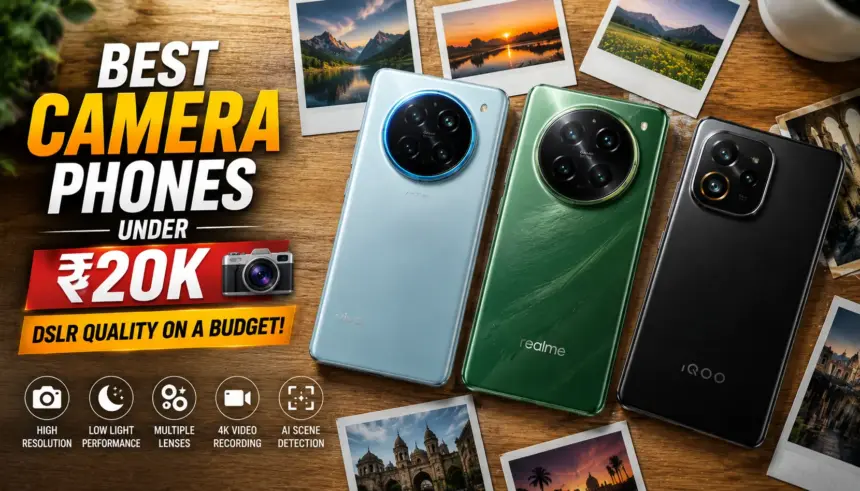
Not long ago, buying a phone under ₹20,000 meant accepting blurry photos, washed-out colors, and terrible low-light performance. In 2026, the camera landscape in the budget segment has completely changed. Manufacturers are now bringing flagship-level hardware—like Sony IMX sensors, Optical Image Stabilization (OIS), and massive 200MP lenses—down to the sub-20K price point.
Whether you are an aspiring Instagram influencer, a college student capturing memories, or a parent who wants sharp photos of their kids running around, you no longer need to spend a fortune to get a great camera.
We have rigorously tested the optics of the latest devices, evaluating their color science, edge detection in portrait mode, low-light noise reduction, and video stabilization. Here is our definitive ranking of the top 10 best camera phones under ₹20,000.
Quick Answer
The absolute best camera phone under ₹20,000 is the Realme Narzo 70 Pro 5G. It uses the flagship Sony IMX890 sensor (found in phones twice its price), delivering unmatched clarity and low-light performance. If you love taking high-resolution photos that you can zoom into without losing detail, the Redmi Note 13 Pro 5G with its 200MP main camera is incredible. For those who prioritize front-facing selfies and vlog-style video, the Vivo T3 5G is the clear winner.
Comparison Table
| Product | Main Camera | OIS Support | Selfie Camera | Best Camera Feature |
|---|---|---|---|---|
| Realme Narzo 70 Pro | 50MP Sony IMX890 | Yes | 16MP | Flagship Sensor |
| Redmi Note 13 Pro | 200MP Samsung ISOCELL | Yes | 16MP | High-Res 4x In-Sensor Zoom |
| Vivo T3 5G | 50MP Sony IMX882 | Yes | 16MP | Portrait Mode & Skin Tones |
| Motorola G84 5G | 50MP (f/1.88) | Yes | 16MP | Natural Colors & Clean UI |
| Samsung Galaxy M34 | 50MP No-Shake Cam | Yes | 13MP | Video Stabilization |
| POCO X6 5G | 64MP | Yes | 16MP | Fast Shutter Speed |
| iQOO Z9 5G | 50MP Sony IMX882 | Yes | 16MP | Great Daylight Dynamic Range |
| Lava Agni 3 5G | 50MP | Yes | 16MP | Stock Camera App |
| Infinix Zero 30 5G | 108MP | Yes | 50MP (4K Video) | Vlogging & Selfies |
| OnePlus Nord CE 3 | 50MP Sony IMX890 | Yes | 16MP | Color Consistency |
Main Content
1. Realme Narzo 70 Pro 5G
Overview: It is incredibly rare to find the 50MP Sony IMX890 sensor—a lens used in premium ₹40,000 flagships—in a sub-20K phone. The Realme Narzo 70 Pro leverages this massive sensor to capture 60% more light than its competitors, resulting in breathtaking night shots and incredibly sharp daylight photos.
* Pros: Flagship-grade main camera sensor; outstanding low-light photography; excellent OIS for stable videos.
* Cons: The 8MP ultrawide camera is strictly average.
* Verdict: The undisputed king of photography in this segment. If the main camera is your only priority, look no further.
2. Redmi Note 13 Pro 5G
Overview: Xiaomi continues to push the megapixel war, equipping the Redmi Note 13 Pro with a staggering 200MP main camera. While megapixels aren’t everything, this massive resolution allows for “In-Sensor Zoom.” You can digitally zoom up to 4x, and the photo will remain as sharp as an optical telephoto lens.
* Pros: Incredible 200MP detail for cropping and zooming; very sharp 1.5K display for editing photos; excellent dynamic range.
* Cons: 200MP photos take up a massive amount of storage space (often 30MB+ per photo).
* Verdict: The perfect phone for photographers who love capturing landscapes or frequently zoom in on their subjects.
3. Vivo T3 5G
Overview: Vivo has always excelled at computational photography, specifically regarding human subjects. The T3 5G features a 50MP Sony IMX882 sensor and Vivo’s legendary portrait algorithms. It flawlessly detects edges (even around curly hair) and applies a beautiful, creamy bokeh effect to the background.
* Pros: Best-in-class portrait edge detection; extremely flattering skin tone color science; lightweight design.
* Cons: Video recording can sometimes hunt for autofocus in low light.
* Verdict: The ultimate choice for Instagram and social media enthusiasts who primarily shoot portraits of friends and family.
4. Motorola G84 5G
Overview: Most budget phones tend to artificially boost colors, making grass look neon green and skies unnatural blue. The Motorola G84 is praised for its natural color science. It captures scenes exactly as your eyes see them, making it a favorite for purists who prefer editing photos themselves.
* Pros: Very natural and accurate color representation; clean, bloat-free camera interface; beautiful vegan leather back.
* Cons: Lacks advanced computational AI features found in Samsung or Vivo.
* Verdict: Best for photography purists who want a clean, honest representation of reality without AI over-saturation.
5. Samsung Galaxy M34 5G
Overview: If you record a lot of videos—whether for YouTube Shorts or family events—the Galaxy M34 is your best bet. Samsung markets its 50MP main lens as a “No-Shake Camera,” featuring excellent hardware OIS paired with software VDIS (Video Digital Image Stabilization) for gimbal-like smoothness.
* Pros: Unmatched video stabilization in this segment; rich, punchy colors characteristic of Samsung; massive 6000mAh battery.
* Cons: Design is outdated (waterdrop notch); charging is very slow.
* Verdict: The safest choice for videographers, vloggers, and parents trying to record their hyperactive children.
6. POCO X6 5G
Overview: While the POCO X6 is primarily a performance device, its 64MP OIS camera is surprisingly capable. What sets it apart is the speed of its Image Signal Processor (ISP), powered by the Snapdragon 7s Gen 2. The shutter speed is incredibly fast, allowing you to capture moving subjects without blur.
* Pros: Zero shutter lag; fast image processing; very sharp 1.5K display for viewing media.
* Cons: Colors can sometimes appear slightly washed out in harsh sunlight.
* Verdict: Great for capturing action shots, sports, or pets where a fast shutter is necessary.
7. iQOO Z9 5G
Overview: Sharing the same Sony IMX882 sensor as the Vivo T3, the iQOO Z9 offers identical camera hardware but slightly different software tuning. iQOO bumps up the contrast and sharpness, resulting in photos that look incredibly punchy and dramatic straight out of the camera.
* Pros: Excellent dynamic range; punchy, contrast-heavy photos; highly capable 4K video recording.
* Cons: Over-sharpens images slightly, especially foliage.
* Verdict: A great option if you want striking, ready-to-post photos that don’t require any filters.
8. Infinix Zero 30 5G
Overview: Often dipping under ₹20,000 during sales, the Infinix Zero 30 is built entirely for vloggers. It is the only phone on this list to feature a massive 50MP front-facing selfie camera capable of recording 4K video at 60 frames per second.
* Pros: Unmatched 50MP selfie camera; 4K 60fps front video recording; 108MP main rear camera.
* Cons: Software processing on the rear camera can be inconsistent.
* Verdict: The absolute best vlogging and selfie camera phone on a budget.
9. Lava Agni 3 5G
Overview: The Lava Agni 3 offers a highly capable 50MP OIS sensor wrapped in a beautifully curved design. Its stock Android interface extends to the camera app, which is incredibly clean, simple, and easy to use without confusing AI gimmicks.
* Pros: Very simple and intuitive camera UI; good daylight clarity; true-to-life colors.
* Cons: Low-light noise reduction struggles compared to Realme and Vivo.
* Verdict: A solid, reliable point-and-shoot experience for users who don’t want to fiddle with complex camera settings.
10. OnePlus Nord CE 3 5G
Overview: The Nord CE 3 features the exact same Sony IMX890 sensor as the Realme Narzo 70 Pro. While it is an older model, price cuts have brought it well under ₹20,000. It benefits from OnePlus’s refined color science and incredibly reliable OxygenOS.
* Pros: Flagship Sony sensor; highly consistent color science; smooth OxygenOS camera app.
* Cons: An older device; software updates will end sooner than newer phones on this list.
* Verdict: A fantastic bargain buy for OnePlus loyalists who want flagship optics at a heavy discount.
Buying Guide
To get the best camera under ₹20,000, ignore the marketing hype and look for these specific hardware features:
* OIS is Mandatory: Optical Image Stabilization (OIS) physically moves the camera lens to compensate for your hand shaking. In 2026, do not buy a phone without OIS. Without it, your night photos will be blurry and your videos will be shaky.
* Sensor Quality > Megapixels: A high-quality 50MP sensor (like the Sony IMX890) will take drastically better photos than a cheap 108MP sensor. Look for specific sensor names (Sony IMX series is generally the gold standard) rather than just high megapixel counts.
* Avoid “Useless” Lenses: Many budget phones advertise a “Triple Camera Setup,” but the 2MP Macro and 2MP Depth sensors are essentially useless marketing gimmicks. Base your purchasing decision entirely on the quality of the Primary (Main) camera and the Ultrawide camera.
* Processor (ISP) Matters: The processor dictates how fast a photo is processed and how well the HDR works. Phones with Snapdragon 7-series or Dimensity 7000-series chips have better Image Signal Processors (ISPs), resulting in better dynamic range and faster shutter speeds.
FAQs
1. Which phone under 20000 has the best night mode?
The Realme Narzo 70 Pro is the best for night photography. Its Sony IMX890 sensor is physically larger than competitors, allowing it to capture more ambient light, resulting in brighter and sharper night shots with less noise.
2. Why do my photos look blurry when I zoom in?
Most budget phones do not have dedicated optical telephoto lenses. When you zoom in, they simply crop the image digitally, which reduces resolution and causes blur. If you zoom frequently, buy the Redmi Note 13 Pro, as its 200MP sensor allows for high-quality “In-Sensor” cropping.
3. Is Samsung better than Vivo for cameras?
It depends on your preference. Samsung (Galaxy M34) is better for videography and punchy, saturated landscapes. Vivo (T3 5G) is vastly superior for human portraits, offering better edge detection and more flattering skin tones.
4. Does Gcam (Google Camera) work on these phones?
Yes, but with varying success. GCam ports work best on phones with Snapdragon processors (like the Motorola G84 or POCO X6). Installing GCam on MediaTek devices (like Vivo or Realme) is often buggy and crashes frequently.
5. Are 200MP cameras a gimmick?
Not entirely, but they are often misunderstood. You should not shoot in 200MP mode all the time (it takes too much storage). The real benefit of a 200MP sensor is “pixel binning”—combining 16 pixels into 1 massive pixel—which produces an incredibly sharp and bright 12MP photo.
Final Verdict
The sub-₹20,000 segment now offers cameras that rival last year’s flagships. If you want the absolute best optical hardware, the Realme Narzo 70 Pro 5G with its Sony IMX890 sensor is an unbeatable steal. If you are an avid portrait photographer who wants to make your friends look flawless on Instagram, the Vivo T3 5G is your best weapon. And if you are a detail fanatic who wants the ability to zoom into landscapes endlessly, the massive 200MP sensor on the Redmi Note 13 Pro 5G is a dream come true.