
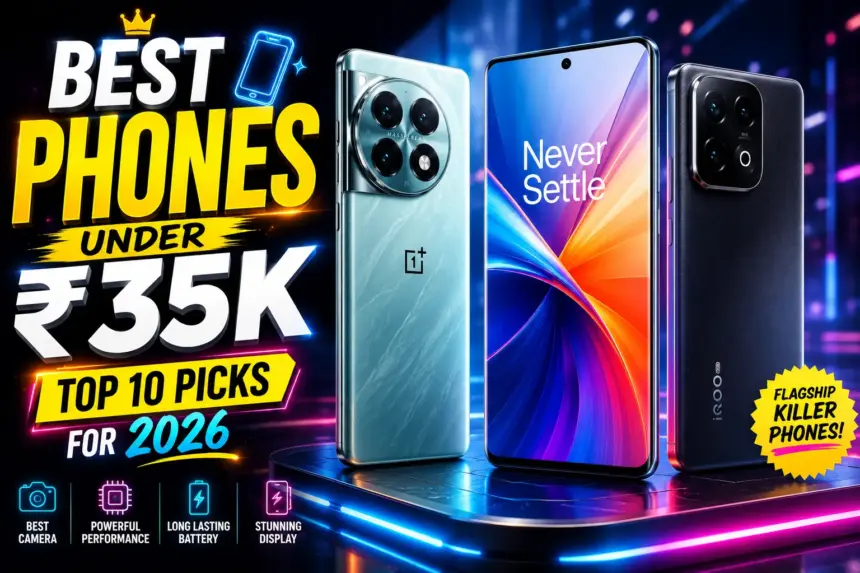
In 2026, the ₹35,000 smartphone segment is the most fiercely competitive category in the Indian market. Gone are the days when you had to spend over ₹60,000 to get a premium glass design, blazing-fast gaming performance, or flagship-grade cameras. Today, this “Flagship Killer” segment gives you 90% of the ultra-premium experience for almost half the price.
Whether you are a hardcore gamer looking for sustained 90fps in BGMI, a content creator needing a stellar portrait camera, or just someone who wants an incredibly fast daily driver that won’t lag for the next four years, the sub-35K market has exactly what you need. We have extensively evaluated the current market to bring you the definitive list of the top 10 best phones under ₹35,000 based on processing power, camera science, battery optimization, and software experience.
Quick Answer
The absolute best all-rounder phone under ₹35,000 is the OnePlus Nord 6, offering an incredibly fluid OxygenOS experience, excellent battery life, and a reliable main camera. If raw gaming performance is your only priority, the iQOO Neo 11 with its flagship-grade Snapdragon processor is unbeatable. For users who prioritize stunning portrait photography and aesthetic design, the Vivo V31 Pro is the clear winner.
Comparison Table
| Product | Processor | Display | Main Camera | Battery & Charging | Best For |
|---|---|---|---|---|---|
| OnePlus Nord 6 | Snapdragon 7+ Gen 3 | 6.74″ 1.5K AMOLED (120Hz) | 50MP Sony IMX890 (OIS) | 5500mAh (100W) | Best All-Rounder |
| iQOO Neo 11 | Snapdragon 8 Gen 2 | 6.78″ 1.5K AMOLED (144Hz) | 50MP (OIS) + 8MP UW | 5160mAh (120W) | Hardcore Gaming |
| POCO F7 | Dimensity 8300 Ultra | 6.67″ 1.5K AMOLED (120Hz) | 64MP (OIS) + 8MP UW | 5000mAh (90W) | Raw Speed & Value |
| Motorola Edge 60 Pro | Snapdragon 7 Gen 3 | 6.7″ Curved pOLED (144Hz) | 50MP (OIS) + 13MP UW | 5000mAh (125W) | Clean UI & Curves |
| Vivo V31 Pro | Dimensity 8200 | 6.78″ Curved AMOLED (120Hz) | 50MP (OIS) + 50MP Selfie | 5000mAh (80W) | Portrait Photography |
| Realme GT 7 | Snapdragon 8s Gen 3 | 6.74″ 1.5K AMOLED (144Hz) | 50MP (OIS) + 8MP UW | 5500mAh (120W) | Gamers & Fast Charging |
| Samsung Galaxy A36 | Exynos 1480 | 6.6″ Super AMOLED (120Hz) | 50MP (OIS) + 12MP UW | 5000mAh (25W) | Brand Value & Updates |
| Nothing Phone (3a) | Dimensity 7200 Pro | 6.7″ Flexible AMOLED (120Hz) | 50MP (OIS) + 50MP UW | 5000mAh (45W) | Unique Tech Design |
| Redmi Note 14 Pro+ | Dimensity 7200 Ultra | 6.67″ 1.5K Curved (120Hz) | 200MP (OIS) + 8MP UW | 5000mAh (120W) | High-Res Photography |
| OPPO F29 Pro+ | Dimensity 7050 | 6.7″ Curved AMOLED (120Hz) | 64MP (OIS) + 8MP UW | 5000mAh (67W) | Lightweight & Fashion |
Main Content
1. OnePlus Nord 6
Overview: OnePlus continues its dominance in the mid-range segment. The Nord 6 strikes a near-perfect balance between performance, software, and battery life. It features the highly efficient Snapdragon 7+ Gen 3, meaning it barely heats up during normal use.
* Pros: Exceptionally smooth OxygenOS animations; massive 5500mAh battery easily lasts two days; incredibly fast 100W charging inside the box.
* Cons: The secondary cameras (ultrawide and macro) feel like an afterthought compared to the stellar main sensor.
* Verdict: The safest and most reliable recommendation for 90% of buyers who want a phone that “just works” flawlessly.
2. iQOO Neo 11
Overview: If you care about Antutu scores and BGMI frame rates above all else, the iQOO Neo 11 is your holy grail. Equipped with a former flagship Snapdragon 8 Gen 2 processor, this phone completely obliterates everything else in this price bracket when it comes to raw processing muscle.
* Pros: Best-in-class gaming performance; massive vapor chamber cooling keeps it cool during long sessions; rapid 120W charging.
* Cons: Funtouch OS is heavily bloated out of the box; design feels a bit plasticky compared to glass rivals.
* Verdict: The undisputed champion for mobile esports players and heavy gamers.
3. POCO F7
Overview: POCO’s legendary F-series is built for speed. The F7 utilizes the MediaTek Dimensity 8300 Ultra paired with ultra-fast UFS 4.0 storage. This means game load times are practically non-existent, and apps install in the blink of an eye.
* Pros: Blistering fast UFS 4.0 storage speeds; excellent 1.5K display is very sharp; great value for money.
* Cons: HyperOS has intrusive system ads that require manual disabling.
* Verdict: The best alternative to iQOO for users who want raw speed on a slightly tighter budget.
4. Motorola Edge 60 Pro
Overview: If you despise bloatware and want a phone that feels like a premium luxury item, the Edge 60 Pro is stunning. It features a vegan leather back, a beautifully curved 144Hz pOLED display, and a completely clean, near-stock Android experience.
* Pros: Zero ads or bloatware; gorgeous curved aesthetic; IP68 water and dust resistance.
* Cons: Camera struggles slightly with edge detection in challenging portrait shots.
* Verdict: The best phone for professionals who want a clean, sophisticated device for office use.
5. Vivo V31 Pro
Overview: The Vivo V series has one mission: to make humans look good. The V31 Pro features arguably the best portrait camera processing under ₹35,000. It even packs a massive 50MP front-facing camera with Eye Autofocus, making it the ultimate tool for vloggers.
* Pros: Industry-leading portrait photography; brilliant 50MP selfie camera; incredibly thin and lightweight design.
* Cons: Single bottom-firing speaker (no stereo speakers); older Dimensity 8200 processor.
* Verdict: The ultimate smartphone for Instagram influencers, vloggers, and selfie lovers.
6. Realme GT 7
Overview: The Realme GT 7 directly challenges the iQOO Neo 11. Packed with the Snapdragon 8s Gen 3, it offers incredibly similar gaming performance but wraps it in a slightly more premium glass and metal design.
* Pros: Fantastic gaming performance; very bright 1.5K display; solid build quality.
* Cons: Realme UI contains several pre-installed third-party apps.
* Verdict: A brilliant high-performance phone that feels slightly more premium in the hand than its gaming rivals.
7. Samsung Galaxy A36
Overview: Samsung’s A36 doesn’t try to win on spec sheets; it wins on trust. It offers a glorious Super AMOLED display, military-grade Knox security, and a guarantee of 4 years of major Android updates—the longest software support in this segment.
* Pros: Phenomenal software support (4 years of OS updates); IP67 water resistance; highly trusted after-sales service.
* Cons: Very slow 25W charging; no charger in the box; thick bezels.
* Verdict: The best choice for parents or users who plan to keep their phone for 4 to 5 years without upgrading.
8. Nothing Phone (3a)
Overview: The Nothing Phone (3a) is a conversation starter. With its transparent back panel and customizable Glyph LED lights, it stands out in a sea of boring glass rectangles. Nothing OS remains the most visually striking and cohesive Android skin available today.
* Pros: Unique, head-turning design; perfectly symmetrical bezels; incredibly smooth and cohesive software.
* Cons: Low-light camera performance is average; processor is slightly weak for heavy gaming.
* Verdict: For tech enthusiasts who value unique aesthetics and software cohesion over raw benchmark scores.
9. Redmi Note 14 Pro+
Overview: Xiaomi pushes boundaries with a massive 200MP main camera on the Redmi Note 14 Pro+. This allows for incredible digital zooming capabilities that almost rival dedicated telephoto lenses. The curved 1.5K display is also one of the brightest in the segment.
* Pros: 200MP camera captures insane detail; lightning-fast 120W charging; very premium curved aesthetic.
* Cons: MIUI/HyperOS bloatware is frustrating; battery life drains quickly on 120Hz.
* Verdict: Best for photography enthusiasts who love zooming in and cropping high-resolution images.
10. OPPO F29 Pro+
Overview: Similar to the Vivo V series, the OPPO F29 Pro+ focuses strictly on design and lifestyle aesthetics. It is incredibly thin, features a massive circular camera module, and is designed to turn heads.
* Pros: Beautiful, lightweight design; great color science for portrait photography; durable build.
* Cons: Severely underpowered processor (Dimensity 7050) for the price; mono speaker.
* Verdict: Strictly a lifestyle and fashion phone for light users who prioritize design over performance.
Buying Guide
When spending ₹35,000 on a smartphone, you need to align the specs with your primary usage. Keep these factors in mind:
* Processor Priority: If you game for more than 2 hours a day, do not compromise on the processor. Look specifically for the Snapdragon 8 Gen 2 (iQOO) or Snapdragon 8s Gen 3 (Realme). Avoid the Exynos or lower-tier Dimensity chips.
* Curved vs. Flat Display: Curved displays (Motorola, Vivo) look incredibly premium and make media consumption highly immersive. However, flat displays (OnePlus, iQOO) are far superior for gaming because they prevent accidental palm touches on the edges.
* Storage Speed: A phone with UFS 3.1 or UFS 4.0 storage will feel significantly faster when opening apps than a phone with older UFS 2.2 storage, regardless of the processor.
* Software Longevity: If you hate changing phones, buy Samsung. They offer 4 years of OS updates, ensuring your phone stays secure and updated longer than Chinese competitors, who typically only offer 2 years.
FAQs
1. Which phone has the best camera under 35000?
The Vivo V31 Pro has the best portrait and selfie cameras, while the OnePlus Nord 6 offers the most reliable “point-and-shoot” main camera experience in diverse lighting conditions.
2. Are curved displays easy to break?
Yes, curved glass is inherently more fragile at the edges than flat glass. It is also significantly harder to find a good tempered glass protector that fits correctly. Always use a high-quality bumper case.
3. Is 8GB RAM enough in 2026?
Yes, 8GB of RAM is perfectly adequate for 90% of tasks, including heavy gaming. However, if you plan to keep the phone for 4+ years, spending a little extra for a 12GB RAM variant is a smart future-proofing decision.
4. Why don’t Samsung and Nothing include chargers in the box?
These companies cite “environmental reasons” to reduce e-waste. However, it also significantly increases their profit margins. Factor in an extra ₹1,500 to buy a compatible fast charger when purchasing these brands.
5. Which brand offers the cleanest software?
Motorola (Hello UI) and Nothing (Nothing OS) offer the cleanest, completely ad-free software experiences in this segment, closely followed by OnePlus (OxygenOS).
Final Verdict
The ₹35,000 segment requires you to make a choice about what matters most to you. For absolute, uncompromising gaming performance, the iQOO Neo 11 is a beast that cannot be tamed. If you want a clean, ad-free experience housed inside a beautifully curved, premium chassis, the Motorola Edge 60 Pro is a joy to use. However, if you want a phone that excels at everything—battery, software, display, and camera—without any major flaws, the OnePlus Nord 6 is the most highly recommended smartphone of 2026.
Internal Links:
- Best Camera Phones Under ₹30,000 in India
- Best Phones with 256GB Storage Under ₹25,000
- Top 10 AMOLED Display Phones
- Nothing Phone 4 vs Motorola Edge 70 Pro
External Links: