
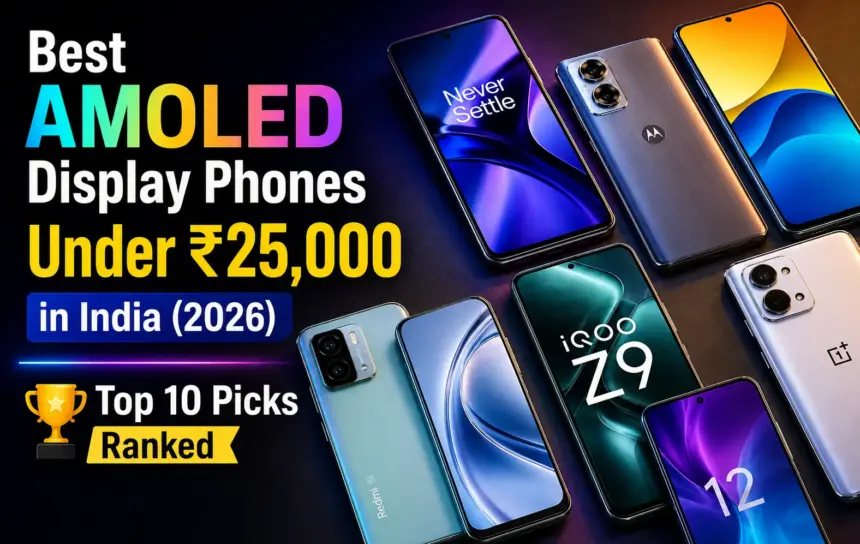
In 2026, the display is arguably the most important component of your smartphone. Whether you are binge-watching Netflix in HDR, scrolling through Instagram, or playing high-frame-rate games, a stunning AMOLED panel completely transforms your experience. Unlike traditional LCD screens, AMOLED displays offer true inky blacks, infinite contrast ratios, and vibrant colors because each pixel illuminates independently.
The sub-₹25,000 segment has become the sweet spot for premium displays. You no longer need a flagship to get 120Hz or 144Hz refresh rates, curved glass aesthetics, or eye-blinding peak brightness levels that work flawlessly under direct Indian sunlight. We have evaluated the market and ranked the top 10 best AMOLED display phones under 25K based on color accuracy, refresh rates, HDR certification, and overall value.
Quick Answer
The best AMOLED phone under ₹25,000 in India is the Motorola Edge 50 Fusion, featuring a stunning 144Hz curved pOLED display with Pantone-validated color accuracy. If you prefer a flat display for gaming, the POCO X6 Pro 5G offers a brilliant 1.5K resolution AMOLED panel with Dolby Vision. For media consumption and deep blacks, the Samsung Galaxy M55 provides a classic, highly reliable Super AMOLED experience.
Comparison Table
| Product | Display Size & Type | Refresh Rate | Peak Brightness | Processor | Best For |
|---|---|---|---|---|---|
| Motorola Edge 50 Fusion | 6.7″ Curved pOLED | 144Hz | 1600 nits | Snapdragon 7s Gen 2 | Curved Aesthetics & Colors |
| POCO X6 Pro 5G | 6.67″ Flat AMOLED (1.5K) | 120Hz | 1800 nits | Dimensity 8300 Ultra | Gaming & High Res |
| Samsung Galaxy M55 | 6.7″ Super AMOLED+ | 120Hz | 1000 nits | Snapdragon 7 Gen 1 | Netflix & Media |
| Nothing Phone (2a) | 6.7″ Flat AMOLED | 120Hz | 1300 nits | Dimensity 7200 Pro | Clean UI & Symmetrical Bezels |
| Realme 12 Pro 5G | 6.7″ Curved AMOLED | 120Hz | 950 nits | Snapdragon 6 Gen 1 | Premium Design |
| iQOO Z9 5G | 6.67″ Flat AMOLED | 120Hz | 1800 nits | Dimensity 7200 | Balanced Value |
| Redmi Note 13 Pro | 6.67″ Flat AMOLED (1.5K) | 120Hz | 1800 nits | Snapdragon 7s Gen 2 | Display & Camera |
| OnePlus Nord CE 4 | 6.7″ Fluid AMOLED | 120Hz | 1100 nits | Snapdragon 7 Gen 3 | Smooth OxygenOS |
| Vivo T3 5G | 6.67″ Flat AMOLED | 120Hz | 1800 nits | Dimensity 7200 | Brightest in Budget |
| Infinix Note 40 Pro | 6.78″ Curved AMOLED | 120Hz | 1300 nits | Dimensity 7020 | Large Screen Experience |
Main Content
1. Motorola Edge 50 Fusion
Overview: Motorola has perfected the mid-range display. The Edge 50 Fusion brings a flagship-grade curved pOLED screen to the sub-25K segment. What sets it apart is its Pantone validation, ensuring that the colors you see on screen are as true-to-life as possible.
* Pros: Gorgeous 144Hz refresh rate makes scrolling incredibly fluid; curved edges offer a premium feel; excellent outdoor visibility.
* Cons: Accidental touches on the curved edges while gaming.
* Verdict: The absolute best display for users who want their phone to look and feel like a ₹60,000 flagship.
2. POCO X6 Pro 5G
Overview: POCO didn’t just put an AMOLED panel in the X6 Pro; they put a 1.5K resolution panel in it. This means the pixel density is significantly higher than standard 1080p phones, making text sharper and games incredibly detailed.
* Pros: 1.5K resolution is rare at this price; supports Dolby Vision and HDR10+; incredibly bright at 1800 nits peak.
* Cons: HyperOS can feel cluttered compared to stock Android.
* Verdict: If you prioritize extreme sharpness and gaming visuals, this flat display cannot be beaten.
3. Samsung Galaxy M55
Overview: Samsung literally manufactures the displays for most of the industry. The Galaxy M55 utilizes their in-house Super AMOLED+ technology, which guarantees deep, inky blacks and punchy, saturated colors that make movies look phenomenal.
* Pros: Superb color saturation; great viewing angles; excellent for watching HDR content on YouTube.
* Cons: Thicker bezels compared to the competition; lower peak brightness (1000 nits) than rivals.
* Verdict: The safest and most reliable display for media consumption and daily use.
4. Nothing Phone (2a)
Overview: The Nothing Phone (2a) offers something extremely rare in the mid-range segment: perfectly symmetrical bezels. The 6.7-inch flexible AMOLED panel sits perfectly flat, providing a highly satisfying, distraction-free viewing experience.
* Pros: Symmetrical bezels look incredibly premium; very high PWM dimming (2160Hz) reduces eye strain at low brightness.
* Cons: Peak brightness is good but not class-leading.
* Verdict: Best for tech minimalists who value uniform design and eye comfort.
5. Realme 12 Pro 5G
Overview: Aimed strictly at the fashion-conscious buyer, the Realme 12 Pro features a luxurious curved AMOLED display that melts into the metal-like frame. It offers a highly immersive experience, especially when watching 21:9 movies.
* Pros: Immersive curved viewing experience; TÜV Rheinland certification for eye protection.
* Cons: 950 nits peak brightness struggles slightly under harsh direct sunlight.
* Verdict: A lifestyle phone with a display built for aesthetics and deep contrast.
6. iQOO Z9 5G
Overview: The iQOO Z9 boasts an aggressively bright AMOLED panel reaching up to 1800 nits locally. This makes it one of the best flat-screen phones for outdoor use in the hot Indian sun.
* Pros: Insanely bright outdoors; excellent touch sampling rate for fast-paced gaming.
* Cons: The “waterdrop” or slightly older punch-hole notch design feels slightly dated.
* Verdict: A brilliant choice for outdoor workers and gamers needing rapid touch response.
7. Redmi Note 13 Pro
Overview: Similar to the POCO X6 Pro, the Redmi Note 13 Pro features a stunning 1.5K AMOLED panel. It strikes a beautiful balance between high-resolution text clarity and 120Hz smoothness.
* Pros: Crystal clear 1.5K resolution; Dolby Vision support; very thin bezels.
* Cons: MIUI/HyperOS bloatware can be annoying.
* Verdict: Excellent for reading ebooks, browsing the web, and high-res photography.
8. OnePlus Nord CE 4
Overview: The Nord CE 4 offers a highly reliable Fluid AMOLED display. While it doesn’t push crazy 1.5K resolutions, it relies on the absolute smoothness of OxygenOS to make 120Hz feel faster than the competition.
* Pros: OxygenOS animations make the display feel incredibly fluid; Aqua Touch feature allows usage with wet hands.
* Cons: Standard 1080p resolution; missing Dolby Vision.
* Verdict: Best for OnePlus loyalists who prioritize software smoothness over raw hardware numbers.
9. Vivo T3 5G
Overview: The Vivo T3 shares the same brilliant 1800-nit panel as its cousin, the iQOO Z9. It delivers exceptionally vibrant colors perfectly tuned for social media consumption and photo editing.
* Pros: One of the brightest flat AMOLEDs available; great color science for viewing photos.
* Cons: Funtouch OS is heavy and takes up system resources.
* Verdict: A solid, bright, and vibrant display tailored for the Instagram generation.
10. Infinix Note 40 Pro
Overview: If you want the biggest screen possible with curved edges on a budget, the Infinix Note 40 Pro delivers a massive 6.78-inch curved AMOLED canvas that feels like a mini-tablet.
* Pros: Massive 6.78-inch size is great for movies; 55-degree curve offers great ergonomics.
* Cons: Viewing angles on the extreme curved edges show slight color shifts.
* Verdict: The ultimate budget phablet for media hoarders.
Buying Guide
When shopping for the best AMOLED phone under ₹25,000, consider the following technical aspects:
* Curved vs. Flat: Curved displays (Motorola, Realme) look more premium and offer immersive media experiences. Flat displays (POCO, iQOO) are better for intense gaming as they prevent accidental palm touches and screen glare.
* Resolution (FHD+ vs 1.5K): Most phones offer 1080p (FHD+), which is fine. However, 1.5K panels (POCO, Redmi) pack more pixels, making text significantly sharper.
* Peak Brightness: If you work outdoors, buy a phone with at least 1300 nits of peak brightness so you can read WhatsApp messages in direct sunlight without squinting.
* PWM Dimming: If you get headaches from looking at screens in the dark, look for phones with high PWM dimming (like 1920Hz or 2160Hz) as they eliminate invisible screen flickering.
FAQs
1. Is AMOLED better than IPS LCD?
Yes. AMOLED screens produce their own light per pixel, allowing for true blacks, higher contrast ratios, and better battery efficiency when using Dark Mode.
2. Does a 144Hz display consume more battery than 120Hz?
Yes, slightly. Pushing more frames per second requires more power. However, most modern phones have “Auto” refresh rates that drop to 60Hz when you are looking at a static image to save battery.
3. Which phone has the brightest display under 25000?
The POCO X6 Pro, iQOO Z9, and Vivo T3 currently offer peak localized brightness levels of up to 1800 nits, making them excellent for outdoor use.
4. Are curved displays fragile?
Curved displays are slightly more vulnerable to edge drops than flat screens and finding a good tempered glass protector can be difficult. Using a solid case is highly recommended.
5. Does an AMOLED screen get screen burn-in?
While possible, modern AMOLED panels in 2026 have pixel-shifting software that prevents static icons (like battery or WiFi indicators) from burning into the screen. It is rarely an issue anymore.
Final Verdict
The sub-₹25,000 segment offers phenomenal display technology. If you want a flagship-like aesthetic with beautiful curves and natural colors, the Motorola Edge 50 Fusion is the clear winner. For hardcore gamers and those who read a lot of text, the flat, high-resolution 1.5K panel on the POCO X6 Pro 5G is unmatched. Finally, for standard media consumption with trusted longevity, you can never go wrong with the Samsung Galaxy M55.
Internal Links (HTML):
- Best Battery Phones Under ₹20,000 in India (2026)
- Best Camera Phones Under ₹30,000 in India
- Top 10 Laptops for Coding and Programming
External Links (HTML):